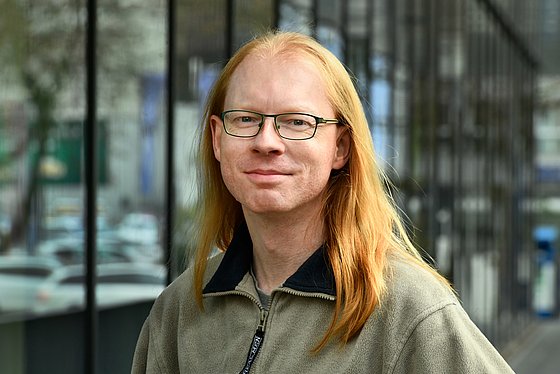
Dr. rer. nat. Michael Hemkemeyer
Akademischer Rat
Lehr- und Forschungsgebiet Boden- und Grundwassermanagement
Institut für Grundbau, Abfall- und Wasserwesen
Fakultät für Architektur und Bauingenieurwesen
Raum HA.00.43
Pauluskirchstr. 7
42285 Wuppertal
Telefon: +49 (0)202 439 4216
Email: hemkemeyer{at}uni-wuppertal.de
Lehrveranstaltungen:
- Geologie, Bodenkunde und Umweltschutz (B.Sc., WiSe)
- Boden und Wasser (B.Sc., SoSe)
- Ökologie und Chemie des Bodens und angrenzender Ökosysteme (M.Sc., WiSe)
- Altlasten und Sanierungsverfahren (M.Sc., SoSe)
Forschungsinteressen:
- Elemente der mikrobiellen Biomasse (Elementom) des Bodens
- Mikrobielle Ökologie der Bodenpartikel
Werdegang:
Seit 03/2025
Akademischer Rat im LuFG Boden- und Grundwassermanagement, Bergische Universität Wuppertal
03/2023 – 02/2025
Projektleitung im Sustainable Food Systems Research Centre, Hochschule Rhein-Waal, Kleve, (DFG-Projekt C:N:P:et al.)
04/2021 – 08/2021
Promotion an der Fakultät für Lebenswissenschaften, Technische Universität Braunschweig
Doktorarbeitstitel: „Importance of soil primary particles for shaping the diversity and activity of soil microbial communities”
01/2016 – 02/2023
Wissenschaftlicher Mitarbeiter in der Arbeitsgruppe Bodenkunde und Pflanzenernährung, Fakultät Life Sciences, Hochschule Rhein-Waal, Kleve (Forschungsprojekte: EffiZwisch, Soil ionoMICS)
01/2011 – 12/2015
Wissenschaftlicher Mitarbeiter in der Arbeitsgruppe Mikrobiologie und Molekulare Ökologie, Thünen-Institut für Biodiversität – Bundesforschungsinstitut für ländliche Räume, Wald und Fischerei, Braunschweig (DFG-Projekt im Rahmen von SPP1513: Biogeochemical Interfaces in Soil)
10/2004 – 09/2010
Biologiestudium am FB 05 Biologie/Chemie, Universität Osnabrück
Schwerpunkte: Ökologie, Mikrobiologie und Zoologie
Diplomarbeitstitel: „Impact of ortho-phenylphenol on soil bacteria and processes”
Publikationen:
Fachartikel:
Wichern, F., Schlösser, C., Meisen, S. A., Hemkemeyer, M. (2026): Cover crop nitrogen uptake: summer drought constraints and mild winter recovery. Nutrient Cycling in Agroecosystems 132: 46. https://doi.org/10.1007/s10705-026-10496-y
Idris, E. E., Hemkemeyer, M., Wichern, F. (2025): Plant growth-promoting potential of Bacillus species isolated from the rhizosphere of crops in Sudan and Saudi Arabia. Journal of Agriculture and Rural Development in the Tropics and Subtropics 126(2): 233–244. https://doi.org/10.17170/kobra-2025081111375
Oskonbaeva, Z., Khan, A. Hemkemeyer, M., Schwalb, S. A., Joergensen, R. G., Wichern, F. (2024): From dry to thrive: Increased metabolic activity, potassium content and a shift towards fungi after drying-rewetting reveals adjustment of the microbial community to osmotic stress. Applied Soil Ecology 202: 105578. https://doi.org/10.1016/j.apsoil.2024.105578
Schwalb, S. A., Hemkemeyer, M., Christensen, B. T., Heinze, S., Oliva, R. L., Joergensen, R. G., Wichern, F. (2024): Disentangling the effects of mineral nitrogen, phosphorus and potassium fertilisation on the soil microbial biomass, necromass and ionome in the Askov long-term field experiment, Denmark. Biology and Biochemistry 195: 109449. https://doi.org/10.1016/j.soilbio.2024.109449
Hemkemeyer, M., Schwalb, S. A., Berendonk, C., Geisen, S., Heinze, S., Joergensen, R. G., Li, R., Lövenich, P., Wu, X., Wichern, F. (2024): Potato yield and quality are linked to cover crop and soil microbiome, respectively. Biology and Fertility of Soils 60: 525–545. https://doi.org/10.1007/s00374-024-01813-0
Joergensen, R. G., Hemkemeyer, M., Beule, L., Iskakova, J., Oskonbaeva, Z., Rummel, P.S., Schwalb, S. A., Wichern, F. (2024): A hitch-hikers guide: estimates of microbial biomass and microbial gene abundance in soil. Biology and Fertility of Soils 60: 457–470. https://doi.org/10.1007/s00374-024-01810-3
Schwalb, S. A, Khan, K. S., Hemkemeyer, M., Heinze, S., Joergensen, R. G., Wichern, F. (2023): Chloroform-labile trace elements in soil via fumigation-extraction: steps towards the soil microbial ionome beyond C:N:P. European Journal of Soil Science 74(2): e13356. https://doi.org/10.1111/ejss.13356
Schwalb, S. A., Li, S., Hemkemeyer, M., Heinze, S., Joergensen, R. G., Mayer, J., Mäder, P., Wichern, F. (2023): Long-term differences in fertilisation type change the bacteria:archaea:fungi ratios and reveal a heterogenous response of the soil microbial ionome in a Haplic Luvisol. Soil Biology and Biochemistry 177, 108892. https://doi.org/10.1016/j.soilbio.2022.108892
Schwalb, S. A., Hemkemeyer, M., Watson, C., Wichern, F. (2021): Mycorrhiza reduces phosphorus uptake from struvite in rye (Secale cereale L.) plants. Journal of Soil Science and Plant Nutrition 21(4): 3451–3460. https://doi.org/10.1007/s42729-021-00619-5
Rummel, P. S., Beule, L., Hemkemeyer, M., Schwalb, S. A., Wichern, F. (2021): Black soldier fly diet impacts soil greenhouse gas emissions from frass applied as fertilizer. Frontiers in Sustainable Food Systems 5:709993. https://doi.org/10.3389/fsufs.2021.709993
Wichern, F., Islam, M. R., Hemkemeyer, M., Watson, C., Joergensen, R. G. (2020): Organic amendments alleviate salinity effects on soil microorganisms and mineralisation processes in aerobic and anaerobic paddy rice soils. Frontiers in Sustainable Food Systems 4:30. https://doi.org/10.3389/fsufs.2020.00030
Hemkemeyer, M., Christensen, B. T., Tebbe, C. C., Hartmann, M. (2019): Taxon-specific fungal preference for distinct soil particle size fractions. European Journal of Soil Biology 94: 103103. https://doi.org/10.1016/j.ejsobi.2019.103103
Hemkemeyer, M., Dohrmann, A. B., Christensen, B. T., Tebbe, C. C. (2018): Bacterial preferences for specific soil particle size fractions revealed by community analyses. Frontiers in Microbiology 9:149. https://doi.org/10.3389/fmicb.2018.00149
Tebbe, C. C., Hemkemeyer, M., Dohrmann, A. B. (2017): Wie wichtig ist die Bodentextur für die Überlebensfähigkeit von eingetragenen Bakterien? Journal für Kulturpflanzen 69: 182. (nicht peer-reviewed) https://doi.org/10.5073/JFK.2017.05
Hemkemeyer, M., Christensen, B. T., Martens, R., Tebbe, C. C. (2015): Soil particle size fractions harbour distinct microbial communities and differ in potential for microbial mineralisation of organic pollutants. Soil Biology and Biochemistry 90: 255–265. https://doi.org/10.1016/j.soilbio.2015.08.018
Hemkemeyer, M., Pronk, G. J., Heister, K., Kögel-Knabner, I., Martens, R., Tebbe, C. C. (2014): Artificial soil studies reveal domain-specific preferences of microorganisms for the colonisation of different soil minerals and particle size fractions. FEMS Microbiology Ecology, 90(3): 770–782. https://doi.org/10.1111/1574-6941.12436
Neumann, D., Heuer, A., Hemkemeyer, M., Martens, R., Tebbe, C. C. (2014): Importance of soil organic matter for the diversity of microorganisms involved in the degradation of organic pollutants. The ISME Journal 8(6): 1289–1300. https://doi.org/10.1038/ismej.2013.233
Neumann, D., Heuer, A., Hemkemeyer, M., Martens, R., Tebbe, C. C. (2013): Response of microbial communities to long-term fertilization depends on their microhabitat. FEMS Microbiology Ecology 86(1): 71–84. https://doi.org/10.1111/1574-6941.12092
Reviews:
Hemkemeyer, M., Schwalb, S. A., Heinze, S., Joergensen, R. G., Wichern, F. (2021): Functions of elements in soil microorganisms. Microbiological Research 252: 126832. https://doi.org/10.1016/j.micres.2021.126832
Heinze, S., Hemkemeyer, M., Schwalb, S. A., Khan, K. S., Joergensen, R. G., Wichern, F. (2021): Microbial biomass sulphur – An important yet understudied pool in soil. Agronomy 11: 1606. https://doi.org/10.3390/agronomy11081606
Pronk, G. J., Heister, K., Vogel, C., Babin, D., Bachmann, J., Ding, G.-C., Ditterich, F., Gerzabek, M. H., Giebler, J., Hemkemeyer, M., Kandeler, E., Kunhi Mouvenchery, Y., Miltner, A., Poll, C., Schaumann, G., Smalla, K., Steinbach, A., Tanuwidjaja, I., Tebbe, C. C., Wick, L., Woche, S. K, Totsche, K.-U., Schloter, M., Kögel-Knabner, I. (2017): Interaction of minerals, organic matter, and microorganisms during biogeochemical interface formation as shown by a series of artificial soil experiments. Biology and Fertility of Soils 53(1): 9–22. https://doi.org/10.1007/s00374-016-1161-1
Buchkapitel:
Babin, D., Hemkemeyer, M., Pronk, G. J., Kögel-Knabner, I., Tebbe, C. C., Smalla, K. (2017): Artificial soils as tools for microbial ecology. In: Steven, B. (Hrsg.): The Biology of Arid Soils. Life in Extreme Environments, Vol. 4. De Gruyter, Berlin, ISBN 978-3-11-041998-6, S. 159–180. (nicht peer-reviewed) https://doi.org/10.1515/9783110419047-009
Tebbe, C. C., Dohrmann, A. B., Hemkemeyer, M., Näther, A. (2017): Microbial community profiling: SSCP and T-RFLP techniques. In: McGenity, T. J., Timmis, K. N., Nogales, B. (Hrsg.): Hydrocarbon and Lipid Microbiology Protocols – Microbial Quantitation, Community Profiling and Array Approaches. Springer, Berlin / Heidelberg, ISBN 978-3-662-52776-4, S. 101–126. https://doi.org/10.1007/8623_2015_158
Transfer / Third mission:
Hemkemeyer, M., Wichern, F. (2025): Zarządzanie międzyplonami i mikrobiomem glebowym wspiera uprawę ziemniaka. https://www.saaten-union.pl/serwis/artykuly/zarzadzanie-miedzyplonami-i-mikrobiomem-glebowym-wspiera-uprawe-ziemniaka/ (nicht peer-reviewed, polnische Übersetzung)
Hemkemeyer, M., Wichern, F. (2025): Zwischenfrucht- und Mikrobiommanagement unterstützen den Kartoffelanbau. Praxisnah 37(4): 26–28. https://www.praxisnah.de/index.cfm/article/12194.html?longversion (nicht peer-reviewed)